US natural gas lost almost a fifth of its value in ten sessions while oil sat near $115 a barrel on the Hormuz crisis. The November Henry Hub contract fell from $3.283 on 13 October to $2.537 this morning, a drop of 23%. The contract that matters next, December, fell far less: from $3.411 on 19 October to about $3.02, roughly 11%.
That gap is the story. A warm autumn crushed the gas nobody needs right now, the expiry week did the rest, and the winter contract still carries a premium. Anyone holding gas through a fund pays for that premium at every roll.
The weather: a heating season that has not started
Every forecast update in the past two weeks pushed the first cold further out. NOAA’s outlooks favoured above-normal temperatures across most of the eastern US into early November, and by Friday meteorologists saw mostly milder-than-normal weather through 7 November.
- Two-week heating degree days ran about 10% below the 10-year norm.
- Residential gas demand stood near 5.1 Bcf/d against a norm of about 7.5 Bcf/d, a third less than usual for the season.
- LSEG’s total demand forecast, exports included, was 106.7 Bcf/d this week and 107.3 Bcf/d next, cut again from Thursday’s outlook.
Late October is the hinge of the gas year: injections should be winding down and heating demand switching on. When the furnaces stay off, gas keeps flowing into storage instead of out of it, and the contract that delivers in November has no buyer who needs it.
Supply: strong exports were not enough
The bull case on paper was solid. LNG export plants pulled a record-level 18.2 Bcf/d in October, with daily flows touching 18.9 Bcf/d, and storage was running only slightly above normal. It did not matter, because the plants are near full capacity: they cannot take more gas however cheap it gets.
| Measure | Latest | Context |
|---|---|---|
| LNG feedgas, October | 18.2 Bcf/d | Record month 18.8 Bcf/d (April) |
| Lower-48 production, October | 111.6 Bcf/d | Record 113.3 Bcf/d (Aug–Sep); last week back near 113.3 |
| Storage, week to 16 Oct | 3,644 Bcf (+77 Bcf) | 1.0% above the 5-year average, 4.0% below last year |
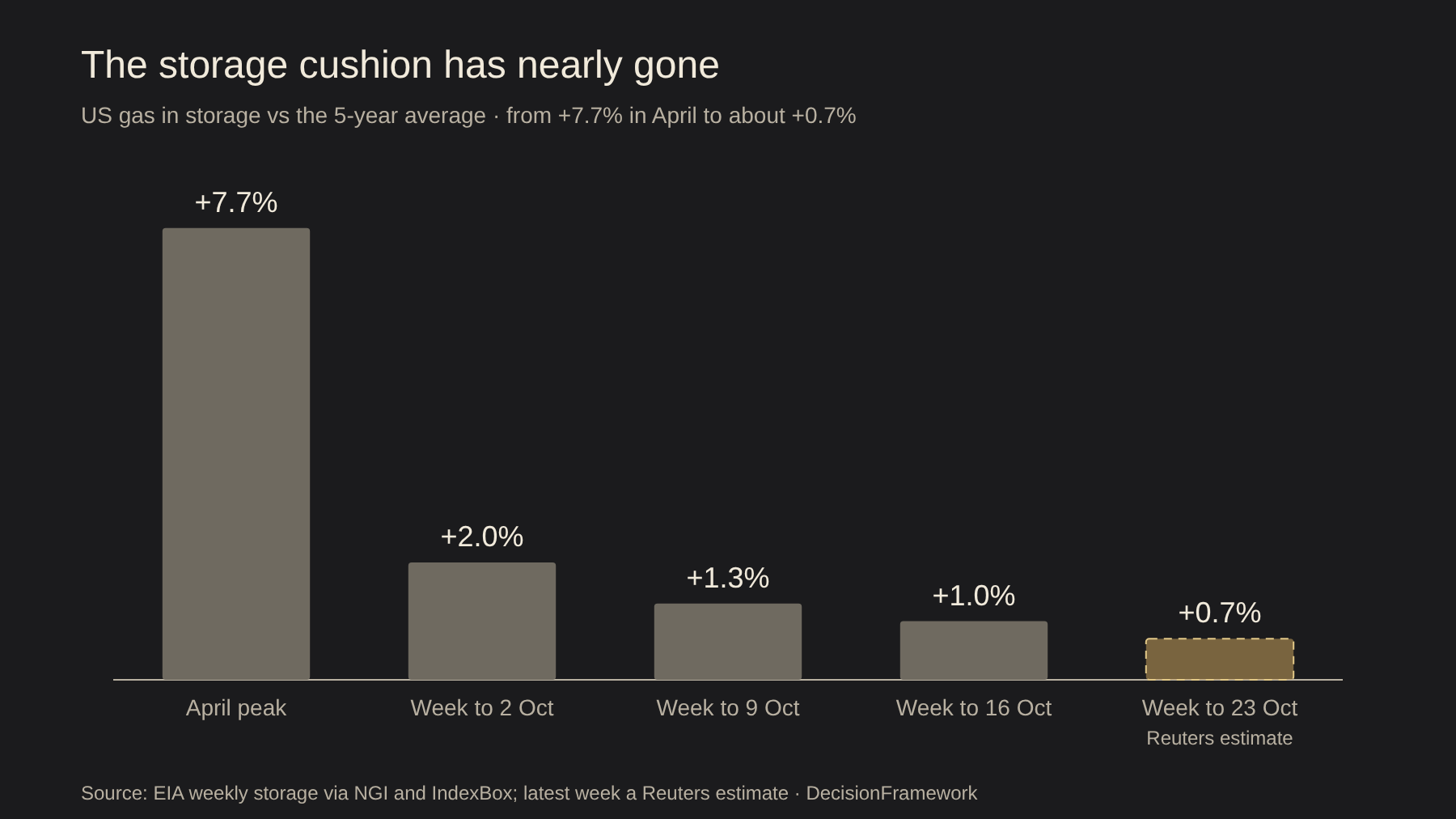
The EIA’s next report, on Thursday 29 October, covers the week to 23 October; Reuters estimates the surplus slipped to about 0.7%. That is mildly bullish, but storage is a slow signal. With production back near its record and exports capped, the swing factor left is the weather, and the weather said no.
The calendar: expiry, the roll and a 19% gap
The November contract stops trading on Wednesday 28 October, three business days before delivery starts on 1 November. In its last days it trades close to physical gas, and physical gas in a warm late October is worth little. December, the first real winter month, does not share that problem.
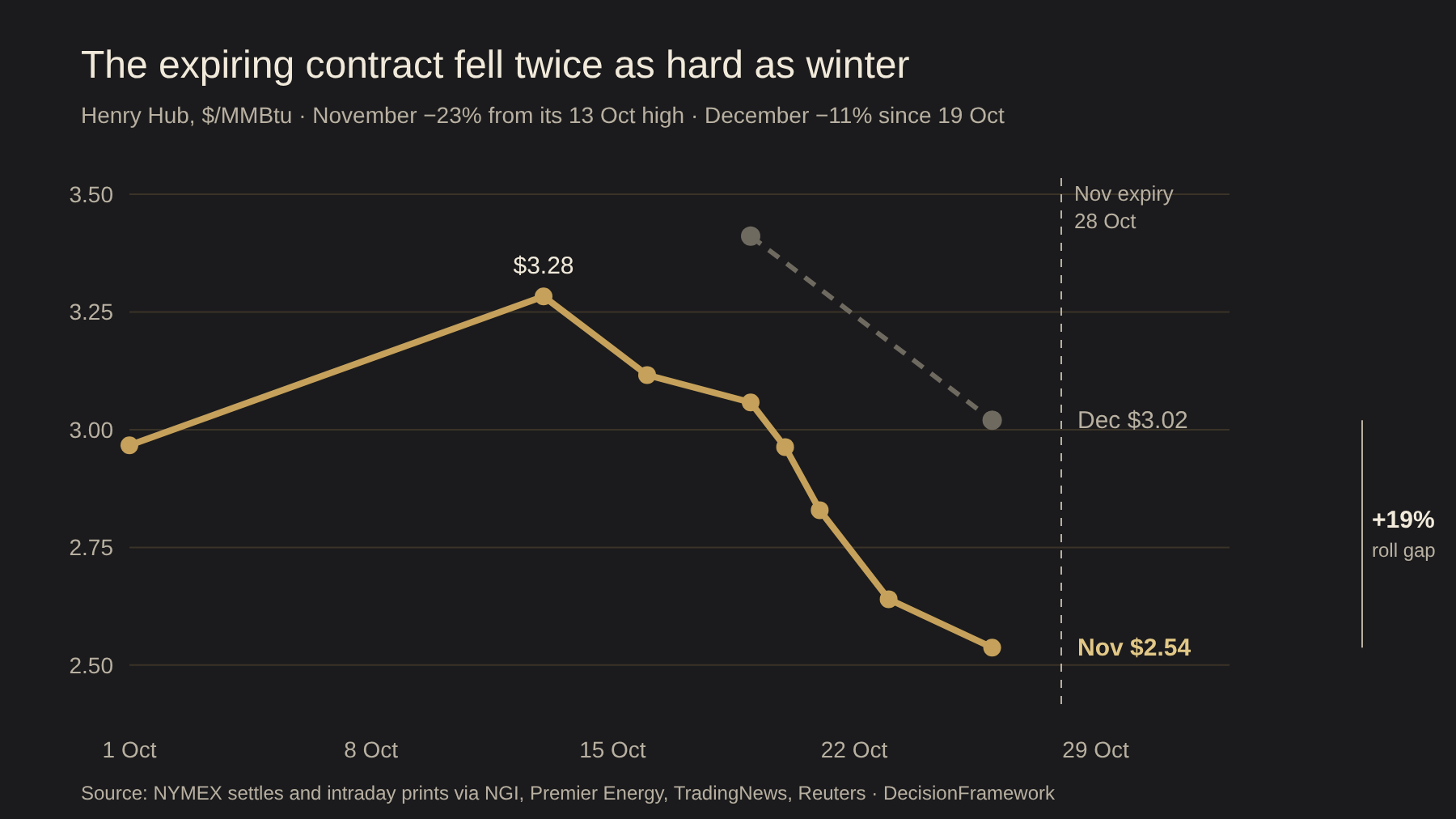
This is contango: the later month costs more than the near one. It has three consequences:
- Continuous charts will jump. Once the front month rolls to December, a continuous NG1! chart steps from about 2.54 to about 3.02 overnight, a 19% “rally” in which nothing happened.
- Funds pay for the gap. An ETF or ETC that holds futures must sell expiring November and buy December. At these prices it ends up with about 16% fewer contracts for the same money, and December has to rise 19% before the holder breaks even on the roll.
- The headline exaggerates. “Gas down 20% in a week” is true for the expiring contract. Most of the winter strip fell half as much: Calendar 2027 slipped to about $3.08, a near five-year low, and the 12-month strip to $2.90.
For a trader, the useful price from Thursday is December on its own, not the front-month chart. The same trap showed up in oil last month: Why Oil Can Fall $7 Overnight Without Anything Happening.
Two gas markets, one crisis
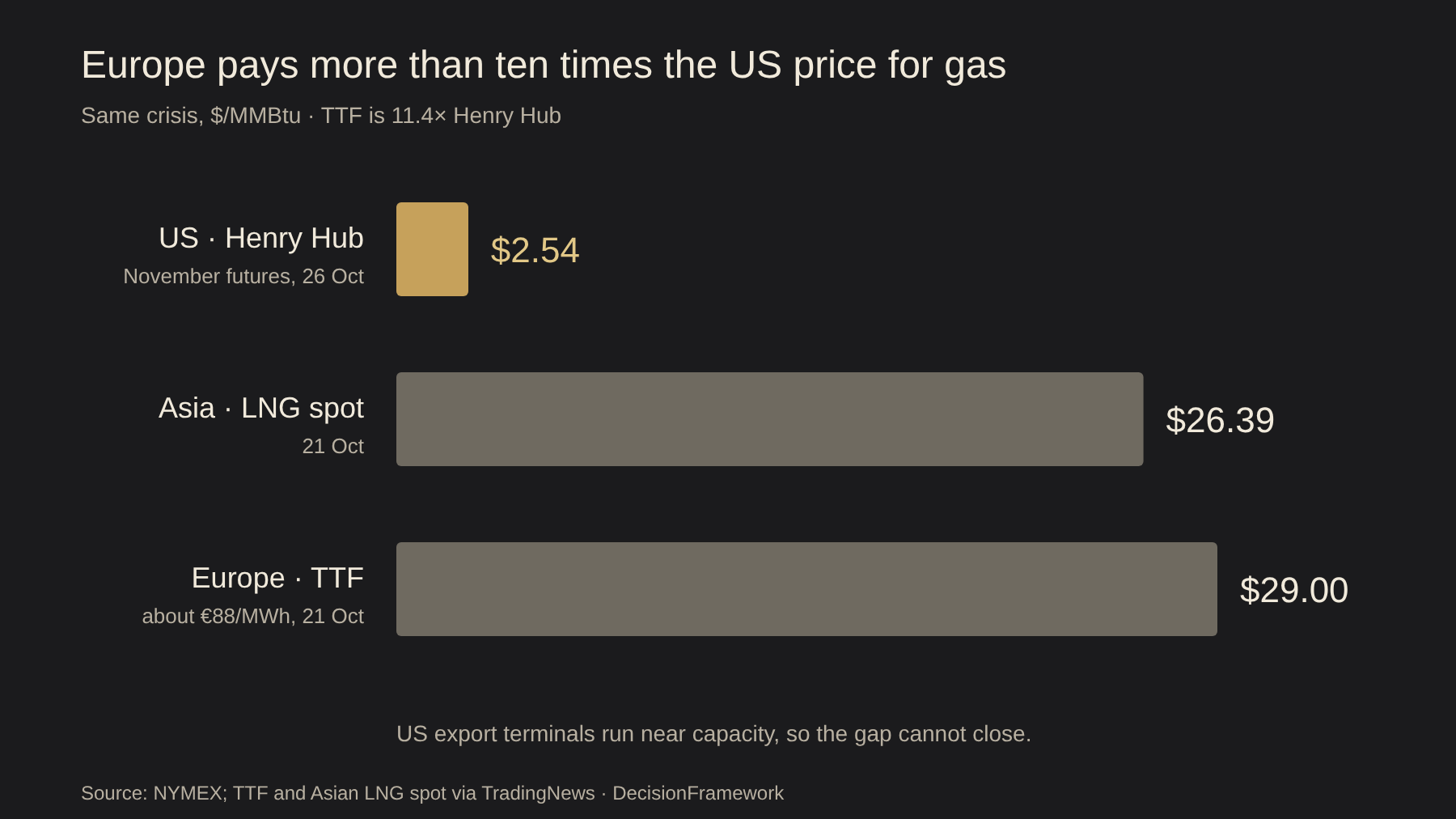
While Henry Hub fell to $2.54, Europe’s TTF benchmark cleared €90/MWh on 20 October for the first time since December 2022. In dollars that is about $29/MMBtu, more than ten times the US price.
| US: Henry Hub | Europe: TTF | |
|---|---|---|
| Main driver | Weather and domestic storage | LNG imports, Hormuz, storage refill |
| Storage | 1.0% above 5-year average | 74.6% full on 18 Oct vs 89% average |
| Hormuz effect | Almost none | Direct: Gulf LNG at 15–25% of prewar |
QatarEnergy has declared force majeure through December, and Gulf LNG exports are a fraction of prewar levels. Europe has to outbid Asia for cargoes, and Goldman Sachs sees TTF needing to top €100/MWh in a cold peak winter if Gulf flows stay low. The UK’s NBP gas price trades on the same LNG logic as TTF.
Europe needs US gas to refill for winter, but the bottleneck is the export terminals, not the gas. Extra European demand cannot pull extra volume out of Louisiana; it shows up as a higher price per cargo, and the spread goes to the exporters and traders. Only new capacity changes that, such as Golden Pass ramping up to a record 0.7 Bcf/d.
Getting exposure, region by region
There are three routes: futures, exchange-traded products that hold futures, and the shares of gas producers. Only futures give you the price you see on the screen. Every fund below rolls futures and pays the contango described above. For the wider picture, see the Commodity ETF Guide.
| Region | Route | Instrument | Notes |
|---|---|---|---|
| Everywhere | Futures, Henry Hub | NYMEX NG (10,000 MMBtu) · Micro Henry Hub (1,000 MMBtu, $1 per tick) | The micro is one-tenth of NG |
| Everywhere | Futures, Europe | ICE Endex Dutch TTF | The European price, in €/MWh |
| US | Futures fund | UNG (front month) · UNL (12-month strip) | UNL spreads the roll over a year |
| US | Leveraged | BOIL (2x) · KOLD (−2x) | Daily reset: for days, not months |
| US | Producer shares | FCG (First Trust Natural Gas ETF) | Company profits, no roll |
| Europe incl. Belgium | ETC | WisdomTree Natural Gas (Bloomberg Natural Gas Subindex, 0.49% a year) | Xetra, Borsa Italiana; EUR-hedged line too |
| Europe incl. Belgium | Leveraged ETC | WisdomTree Natural Gas 3x Daily Short (3NGS, NGXS), plus a 3x long | 0.99% a year; second-month NYMEX |
| UK | ETC | WisdomTree Natural Gas on the LSE in USD (NGAS) and GBP (NGSP); 3x lines 3NGS / 3LGS | Same products as in Europe |
| Canada | Leveraged ETF | BetaPro Natural Gas Leveraged Daily Bull (HNU, TSX), 2x | 1.31% a year |
| Asia, Australia, rest of world | Futures | NYMEX and ICE contracts through an international broker | Few local listed gas funds |
- US funds are usually off limits in Europe. UNG, BOIL and the like publish no European key information document, so EU retail brokers generally do not offer them.
- Belgium restricts CFDs. The FSMA bans the distribution of certain CFDs to retail clients, so ETCs and futures are the realistic routes. Stock-exchange tax (TOB) applies to ETC trades; check your broker’s rate.
- Check which gas you are buying. Almost every listed gas product tracks Henry Hub. Exposure to Europe’s TTF, the market that moves with Hormuz, mostly means trading the ICE futures directly.
The quiet inflation offset
Brent rose more than 20% in October, to $116.72 on 23 October, yet the US 10-year breakeven inflation rate barely moved. It stayed in a 2.32–2.37% range all week and stood at 2.34% on Friday.
Cheap gas is part of the reason. In the US, gas heats homes and sets the price of much of the electricity, so a 20% fall works against the oil shock in household energy bills. The broad commodity index and the 10-year TIPS real yield tell the same story: oil alone is not lifting the whole energy complex, and the market treats $115 Brent more as a drag on growth than as a new inflation wave. On 22 October about 70% of the drop in the 10-year yield came from real yields, not inflation expectations.
The live version of that comparison, the 10-year TIPS real yield against the broad commodity index, is on Real Interest Rates & the Dollar.
For gold that matters. Inflation expectations that stay anchored keep the focus on real yields, the line that decides what it costs to hold a metal that pays nothing.
What to watch this week
- Wednesday 28 October: November expiry. From Thursday, December is the front month and continuous charts jump about 19%.
- Thursday 29 October, 16:30 Brussels: EIA storage for the week to 23 October. A surplus below 0.7% would be the first bullish signal in weeks.
- The first cold: any forecast that pulls cold weather into the first half of November, because December’s premium already prices a normal winter.
- LNG: feedgas back near 18.9 Bcf/d and Golden Pass ramping are the only ways US gas reaches Europe’s €90 market in larger volumes. Background on the Strait: The Strait Is Closed. The Oil Is Flowing.
- TTF above €100/MWh: the level Goldman Sachs flags if Gulf LNG stays low into peak winter.
Get market notes like this by email
Short notes on the moves and mechanics behind gold, from a trader’s point of view. Subscribers also get the free preview of The Gold Investor in their language, and the full book for €35 instead of €38.
You'll get a confirmation email first. Occasional emails on gold, real rates and the dollar. Unsubscribe anytime. Or read the preview first.
The live desk is open. Use it while it’s free.
The indicators behind these articles: real rates, the dollar balance, crack spreads, metal ratios, the levels watch and the Hormuz tracker. They may move into the private Client Area at any moment, without announcement. Readers who pre-register their licence code keep access as founding readers.
Open the desk →Sources
- Reuters via Business Recorder, “US natgas prices fall on milder weather forecasts”, 25 October 2026.
- Premier Energy Management, “Natural Gas MarketWatch, October 20, 2026”.
- TradingNews, “NG ($2.829) sinks 4.5% on mild weather”, 21 October 2026.
- NGI, “Natural Gas Prices Crater as Weather Demand Drops”, 21 October 2026.
- IndexBox, “EIA reports 77 Bcf weekly build” (EIA data), 22 October 2026.
- TokenPost, “European Gas Futures Top €90 for First Time Since December 2022”, 20 October 2026.
- The Lead-Lag Report, “Treasuries Are a Hedge Again. Credit and Oil Explain Why.”
- MacroRadar, 10-Year Breakeven Inflation Rate.
- Gulf News, “Crude oil’s weird Monday”, 26 October 2026.
- CME Group, Micro Henry Hub Natural Gas futures.
- WisdomTree, Natural Gas 3x Daily Short; onvista, WisdomTree Natural Gas ETC.
- StockAnalysis, BetaPro Natural Gas Leveraged Daily Bull ETF (HNU); ETF Beacon, Natural gas ETFs.
- FSMA, CFD.
Prices as of the morning of 26 October 2026; the December price is a trader’s quote, not an exchange settlement. Product details change; check the issuer and your broker before trading. Educational content to support your own research and decisions. Not financial advice.