Gold just had its worst September in 15 years, and physical buyers bought more of it than at any time since 2021. That is the story of the last six weeks: rising interest rates knocked the price down, and the people who hold metal treated the drop as an opening.
The September paradox
The dollar gold price fell 8.5% in September 2026, its steepest drop for that month in 15 years. US 10-year yields near 5.10% made bonds look attractive again, and the textbook says gold should struggle when holding it costs you a 5% coupon.
Buyers did not read the textbook. BullionVault’s clients added 389 kg of gold net in September, the heaviest inflow since June 2021 and worth about $54 million. The number of sellers fell 26.5% to its lowest since December 2024. The platform’s Gold Investor Index rose to 55.9, its highest since June and above the five-year average of 54.2.
Silver told the same story with more volatility: the price fell 13.6%, yet buyers have outnumbered sellers on the platform for 20 months in a row.
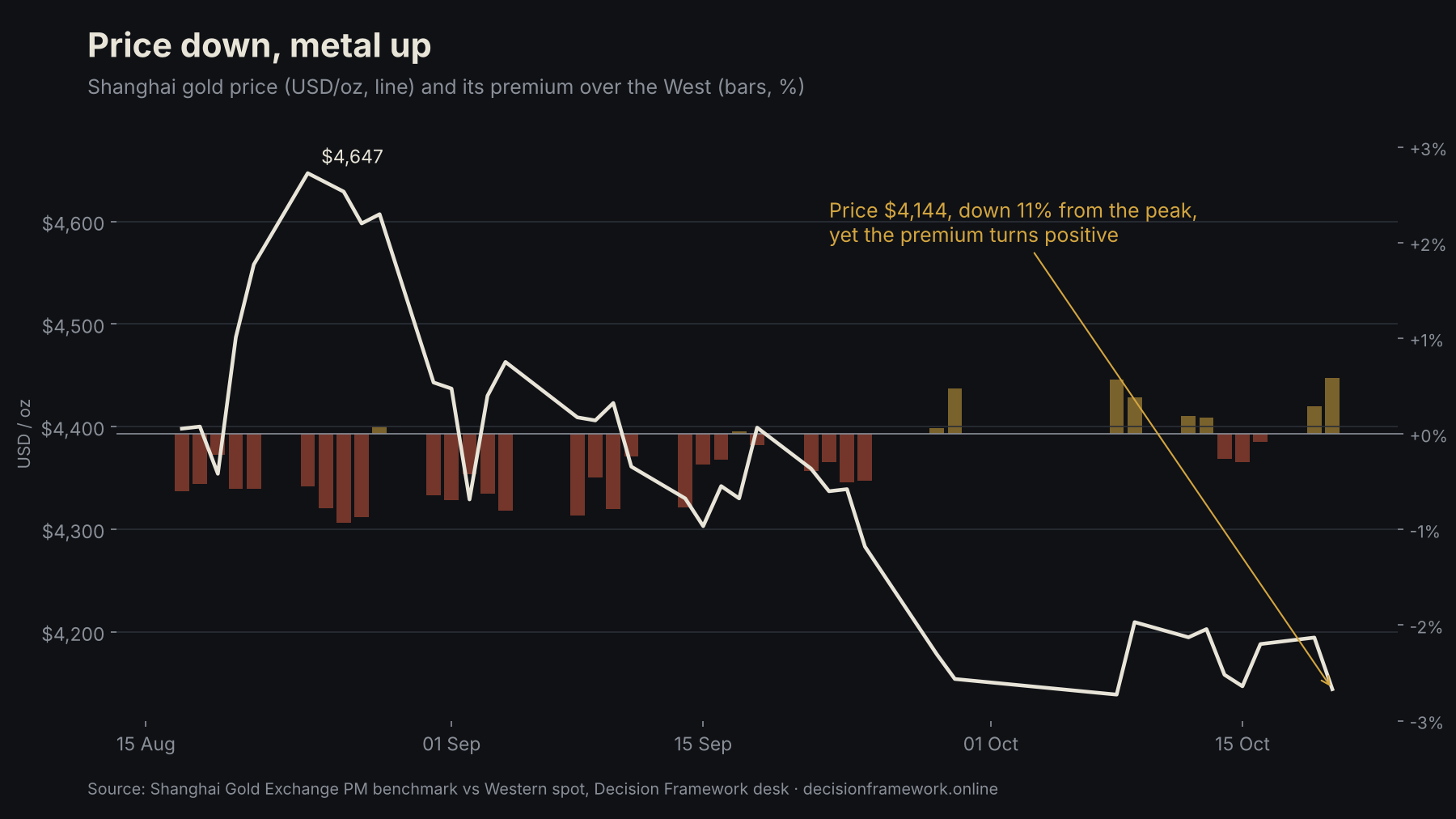
One caveat matters. These are one platform’s clients, mostly in Western Europe and North America. They are a sample of private investors, not the whole market. But the same pattern shows up far from London.
The East pays up
The clearest signal comes from Shanghai. On the Shanghai Gold Exchange benchmark of 20 October, gold traded $24.11 an ounce above Western spot, a premium of +0.59%. That was double the previous day, and a sharp turn from August and September, when Shanghai gold traded at a steady discount to London.
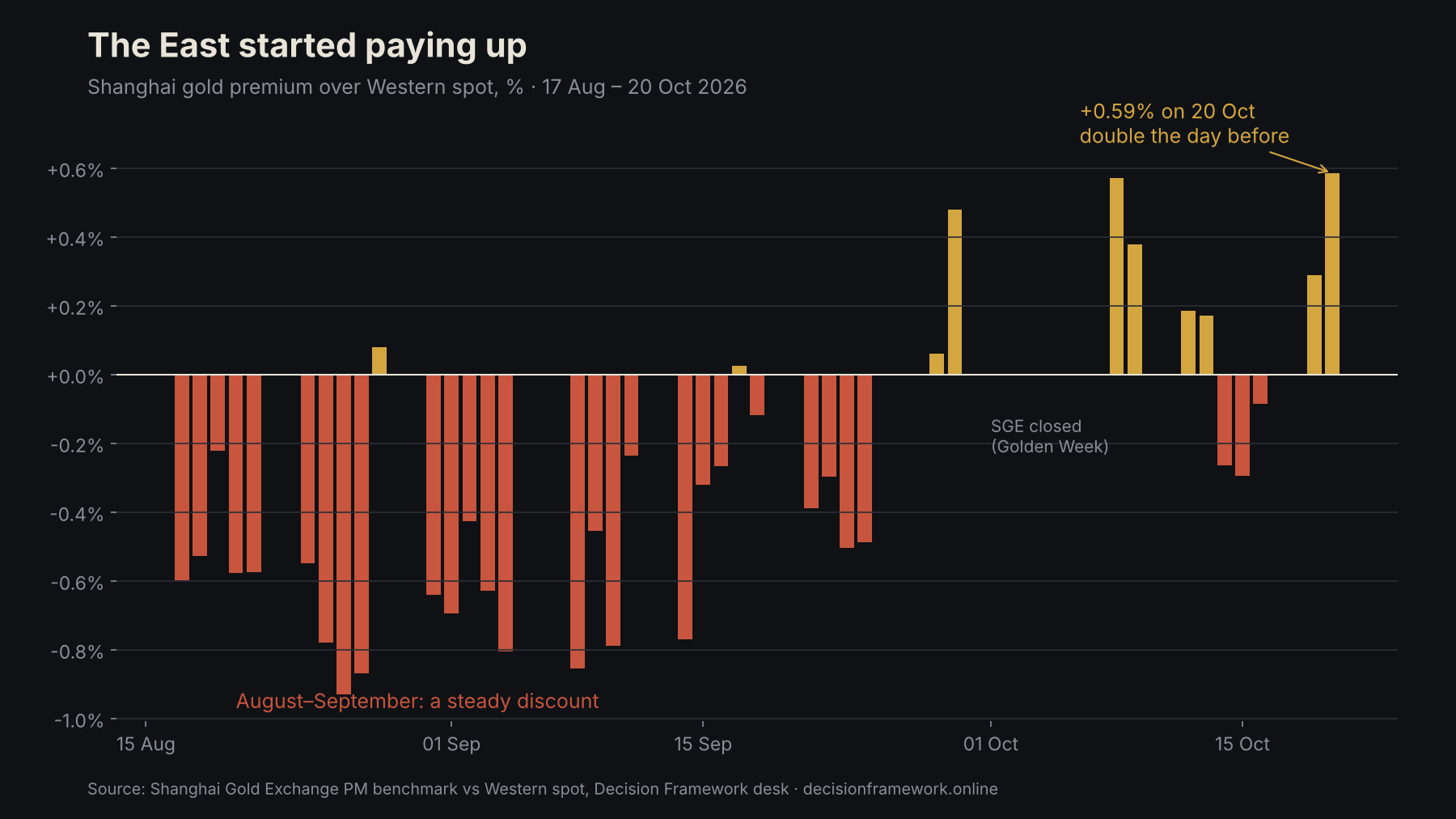
The premium widened on a day when the Western price fell. Chinese buyers paid more for physical metal precisely as paper markets sold it. Import incentives into China ran at about $22 an ounce, roughly three times the usual level, even as the yuan hit a four-year high against the dollar.
India is adding its own pull. Diwali falls in early November and the wedding season is underway; dealers there were charging around $5.50 an ounce over official import costs in October. Funds are joining in too: worldwide gold ETFs now hold a record 4,278 tonnes, and Asian-listed funds supplied nearly a fifth of the growth over the last three months.
Not the AI trade
Gold is not moving with the technology boom, and that is a feature. Over eight straight losing sessions to 16 October, the Philadelphia semiconductor index fell 15.7% while gold rose 0.8%. In the last two of those days, chip stocks lost 4.7% and gold gained 2.4%.
The relationship is not fixed. In an earlier chip sell-off to the end of July, gold fell alongside. But the recent cracks in the debt-funded AI build-out, from data-centre power delays to heavy insider selling, have pushed money toward assets that do not depend on that boom continuing.
For a portfolio already heavy in technology, that low correlation is the point of owning gold.
What the industry expects
The professionals are cautious on the next few months and bullish beyond them. At the LBMA precious-metals conference in Sorrento in early October, about 1,000 delegates raised their average 12-month gold forecast from $4,895 to $5,013 over two days. Their silver call was $100 an ounce by October 2027.
The short-term caution has a reason: jewellery demand is down 10 to 20%, and high yields compete for every safe-haven dollar. The long-term confidence rests on central banks. Delegates almost unanimously expect them to keep buying, or buy faster, over the next five years. Bundesbank President Joachim Nagel told the room that rising debt and geopolitical risk keep the case for diversifying into gold strong.
One group has barely arrived yet: large institutions such as US pension and insurance funds. Several speakers expect a bond-market shock to be what finally brings them in.
What to watch next
Rates set the price; physical demand sets the floor. Four markers will tell which side wins into the end of the year:
- US real yields. The first rule on the desk. As long as real yields keep rising, the price has a headwind, whatever buyers do.
- The Shanghai premium. A premium that holds above zero while Western spot falls means the East is absorbing the selling. A slide back to a discount would remove the floor. Background: Gold Has Three Prices.
- India into Diwali. Early November is the seasonal peak. Watch whether local dealer premiums widen or fade.
- The geopolitics of supply. China’s rare-earth squeeze on Japan, near-zero visible tanker traffic through Hormuz and the US–Russia diesel arrangement all point the same way: states want assets nobody else can print, freeze or ration. The Trump–Xi meeting in early November is the next dated test.
Write it down
The September lesson is simple. A falling price is not the same as falling demand. Before you act on a drop, write down who is buying it: Western private investors, Chinese and Indian physical buyers, ETFs, or central banks. Watch who is buying, not only what the screen says.
Get market notes like this by email
Short notes on the moves and mechanics behind gold, from a trader’s point of view. Subscribers also get the free preview of The Gold Investor in their language, and the full book for €35 instead of €38.
You'll get a confirmation email first. Occasional emails on gold, real rates and the dollar. Unsubscribe anytime. Or read the preview first.
The live desk is open. Use it while it’s free.
The indicators behind these articles: real rates, the dollar balance, crack spreads, metal ratios, the levels watch and the Hormuz tracker. They may move into the private Client Area at any moment, without announcement. Readers who pre-register their licence code keep access as founding readers.
Open the desk →Sources
- BullionVault, “Gold Investing Leaps as Surging Interest Rates Zap Prices”, Adrian Ash, 9 October 2026.
- BullionVault, “LBMA 2026 Conference: Short-Term Cautious, Long-Term Bulls”, Adrian Ash, 16 October 2026.
- BullionVault, “Gold Slips as Tech Stocks Rally from AI Sell-Off”, Atsuko Whitehouse, 19 October 2026.
- BullionVault, “Gold Rallies as China and India Prices Signal Stronger Demand”, Adrian Ash, 20 October 2026.
- Shanghai Gold Exchange PM benchmark against Western spot, recorded daily on the Decision Framework desk; cross-checked with MetalCharts, China gold price.
- Financial Times, reported via Yahoo Finance, “Japan nears rare earth shortage as China tightens supply”, 20 October 2026.
BullionVault client figures describe one platform’s customers, mostly in Western Europe and North America. Premium levels depend on the reference price used. Educational content to support your own research and decisions. Not financial advice.